David and Tamler welcome Paul Bloom back to the show for a definitive ranking of classic psychology experiments. Will the shocking results of the Milgram studies earn him a posthumous 'S' ranking? How far will Zimbardo fall? Is the Stroop effect a super effect? Did you see the Gorilla in these notes? Which is more plausible: that we have Paul Bloom as a guest, or we have Paul Bloom and a guest and it's a banger? Note: no dogs or baby monkeys were harmed in the making of this episode.
Final Tier List Rankings (episode spoilers!)
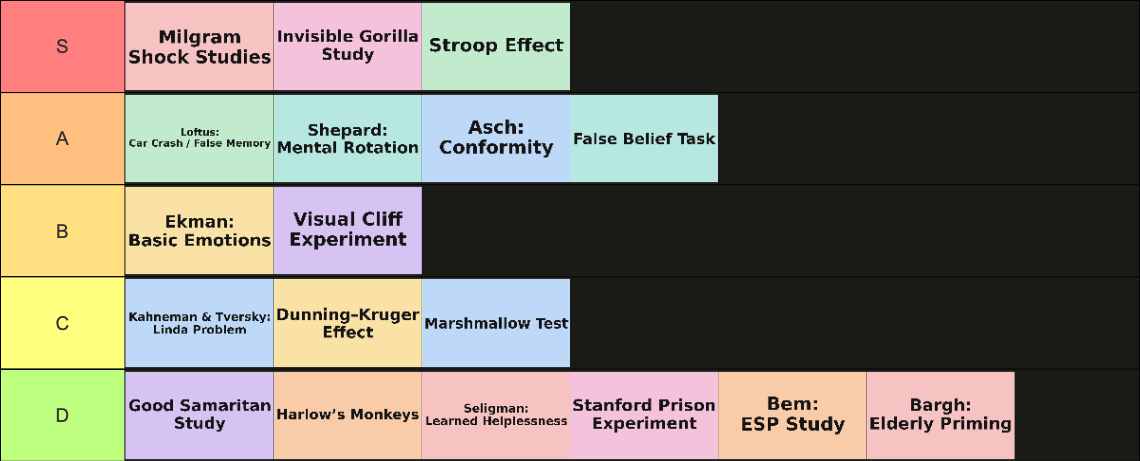
List of Studies Ranked (all links are to pages on wikipedia.org)
[00:00:00] [SPEAKER_00] Very Bad Wizards is a podcast with a philosopher, my dad, and psychologist Dave Pizarro having an informal discussion about issues in science and ethics. Please note that the discussion contains bad words that I'm not allowed to say and knowing my dad some very inappropriate jokes.
[00:00:17] [SPEAKER_04] Who is writing this? You're doing this? This is your life! Oh my god almighty, I'm not part of this!
[00:00:28] [SPEAKER_01] The Great End Hunt!
[00:01:13] [SPEAKER_10] Welcome to Very Bad Wizards, I'm Tamler Sommers from the University of Houston. Dave, all I'm hearing about these days is the hugging face incident and some guy who resigned from his job at Anthropic, and now all of a sudden Ezra Klein is writing columns, Dario from Anthropic is writing manifestos. What happened and how is this affecting your P-Doom?
[00:01:39] [SPEAKER_05] I can't summarize the hugging face incident because I've been like, I honestly have ignored, I've tried to ignore what hugging face is. It's interesting. It's got, like, do you have the feeling that it's gotten to religious fervor right now?
[00:01:54] [SPEAKER_10] Yes, but everybody's gonna be very mad at us.
[00:01:56] [SPEAKER_05] I know, I know. But look, look, I'm not claiming I know. I'm just saying. All I see on Twitter is people saying, like, you guys are all dumb for not believing this, you guys are all dumb for believing this, you guys have no arguments. No, you guys have no arguments.
[00:02:12] [SPEAKER_10] Yeah, well, that's why we're devoting the whole episode today to go through all the details behind the hugging face incident, what it may represent, and how it may have been misinterpreted. And we have three leading experts joining. No, none of that. But we do have a great show lined up today. We had Paul Bloom on to tier rank psychology thought experiments.
[00:02:39] [SPEAKER_05] No, no, no, no, no, no, no. Psychology experiments.
[00:02:41] [SPEAKER_10] Sorry.
[00:02:42] [SPEAKER_05] It's like, actually, somebody actually did them.
[00:02:45] [SPEAKER_10] In some cases, yeah. It was a fun, but also very long conversation. So should we just leave it there and get to it?
[00:02:58] [SPEAKER_05] Yeah, I mean, unless you want to share your P-doom, like, are you afraid to share yours?
[00:03:03] [SPEAKER_10] I'll show you my P-doom if you show me yours. All right. Should we just get to the episode?
[00:03:10] [SPEAKER_05] Yeah, let's do it.
[00:03:11] [SPEAKER_10] All right, let's get to our main segment. And we have our favorite guest returning, Paul Bloom. Welcome back.
[00:03:19] [SPEAKER_02] I am thrilled to be back. It always feels like it's been too long. I got to say, I've been following your Odyssey discussions. And I think it's amazing. It got me to read the book. I've been reading a bit of the book and rewarding myself with reading your podcast about it. But so my fanhood, if anything, has sort of magnified over recent times.
[00:03:37] [SPEAKER_05] That's so kind of you.
[00:03:38] [SPEAKER_02] That's great to hear. Are you reading the Emily Wilson? Yeah, because I'm in favor of women. Yeah. Have you heard she's doing another one?
[00:03:45] [SPEAKER_05] Yeah.
[00:03:46] [SPEAKER_02] Yeah. I imagine her publishers must have mixed feelings about this. But she's doing another one. Did you translate the same thing twice?
[00:03:52] [SPEAKER_10] Well, you know why. So in the first one, she limited herself to the number of lines that were in the original. And then she didn't do that for her Iliad. And she liked the freedom of being able to add a few extra lines here and there. And so that's all she's going to do for the revised version, I think. Interesting. Is just release herself from that constraint. Still going to be the iambic pentameter. It's still going to be, you know, I think fairly concise compared to some of the other ones, especially Fagels. But yeah.
[00:04:23] [SPEAKER_05] Do you think she's going to stick to her guns with the opening line?
[00:04:27] [SPEAKER_10] Complicated man? Yeah.
[00:04:29] [SPEAKER_02] Yeah. At this point, changing that seems like she's going to be trolling. She has a book coming out about translation, which I think I'm going to get. I listened to her a few times and she seems super smart and really engaging. Yeah.
[00:04:40] [SPEAKER_05] We've wanted to talk about translation, but haven't found an angle to it. So maybe that will be. Maybe we can get Emily Wilson on it. You got to get her on the pod.
[00:04:49] [SPEAKER_10] Do we know anybody who knows her? I think that given all the business we've sent her away, she owes it to us.
[00:04:56] [SPEAKER_02] Yeah. She'll give you the gratitude she gave to Nolan. Yeah. She's not big on gratitude, I think. One star iTunes review. She'll write two separate attacks on your podcast. One thing we're doing is saying what a shitty podcast it is.
[00:05:10] [SPEAKER_10] Repugnant on Apple Podcast and submoronic on Spotify.
[00:05:17] [SPEAKER_05] All right. So we are going back to our tier list format. So Paul had listened to our philosophy thought experiment tier list episode. And actually, I think, Paul, you pitched the doing a psych studies.
[00:05:32] [SPEAKER_02] I did. I mean, I'm going to stop with the praise, but that was one of your best episodes. If I had somebody who was interested in philosophy or thinking about philosophy, maybe go into it, I would give them that episode on your thought experiments. It was such an engaging discussion. It was so much fun. But as I was listening to it, texting David and bitching about your choices. I think you did trolley problem wrong. I think you gave it a very low score at one of the most terrifically appealing dilemmas.
[00:05:58] [SPEAKER_10] It's the gift that keeps on giving trolley problems. Exactly.
[00:06:02] [SPEAKER_02] Not a day goes by where I don't see a trolley problem. But a lot of your other choices were exactly right. You crapped on the utility monster, as well you should. And then I sent David really obscure thought experiments and complained you didn't discuss it.
[00:06:17] [SPEAKER_10] Like, what did you want us to discuss?
[00:06:18] [SPEAKER_02] Actually, we weren't so obscure, but you didn't talk about H2O and XYZ.
[00:06:22] [SPEAKER_10] Oh, yeah.
[00:06:23] [SPEAKER_02] The hill of Putnam.
[00:06:24] [SPEAKER_10] Twin Earth, we didn't talk about Swamp Man. Oh, you didn't talk about Swamp Man?
[00:06:28] [SPEAKER_05] Yeah, no, we didn't talk about Swamp Man. I didn't know the difference between Swamp Man and the transporter problem. They're related. Yeah.
[00:06:35] [SPEAKER_10] And Swamp Man is if the transporter problem and zombies had a kid.
[00:06:40] [SPEAKER_05] Yeah. Into a genealogy. But that's not what we're doing today. Today we are doing science. Yes. So, you know, there are answers to this. This isn't just a vibes-based tier list. These are objectively...
[00:06:55] [SPEAKER_10] We should tell people what a tier list is. Yes. It's pretty simple. You will get an experiment, like the Milgram experiments, which I'm sure will be on here. And then we put it in the D, which is the lowest, the C, second, all the way up to B, A, and S. S tier is like super special, right? Yes. It's the superlative.
[00:07:16] [SPEAKER_05] Are there rules about how many per tier?
[00:07:19] [SPEAKER_02] We don't have to rank them. No.
[00:07:20] [SPEAKER_05] I think the only rule is that we have to agree. Okay, good. Or compromise, maybe, is the better word than agree.
[00:07:26] [SPEAKER_02] For the thought experiment you did, give me an example. What was an S? What made the S? Do you remember?
[00:07:32] [SPEAKER_05] Ooh.
[00:07:33] [SPEAKER_02] God, no.
[00:07:34] [SPEAKER_05] You didn't.
[00:07:36] [SPEAKER_10] Did you have anything? Do I remember any of them? The cave? Plato's Cave? But I don't think you even had that. But I would have put that in there. We called some audibles at the end that ended up being. Descartes' Evil Demon, maybe. Yeah. The classics. Yeah. Yeah, exactly. We used to have thought experiments in this country. Or, well, not this country.
[00:08:02] [SPEAKER_05] Okay, so we have.
[00:08:03] [SPEAKER_02] I guess the question of what dimension do we rank doesn't really have an answer. Just all goodness.
[00:08:08] [SPEAKER_10] Oh, yeah. We should talk about this. Like, are we going to incorporate ethical concerns? Are we just talking about its contributions to science or to human understanding or understanding of the mind? What do we take into account here?
[00:08:21] [SPEAKER_05] Good question. I was thinking that it would be, one, a holistic evaluation. Yeah. Yeah. Which is a very important thing. The quality of the actual experiment, the impact it had on the field, the, like for me, there's some category of the cleverness of the finding. It's not necessarily counterintuitive, but you wouldn't have thought to do it that way. And replicability, probably.
[00:08:46] [SPEAKER_02] Some are shockingly unethical. Yeah. And that also makes them rather memorable. Yeah.
[00:08:51] [SPEAKER_05] That was a pun, almost.
[00:08:53] [SPEAKER_02] Oh, I was actually thinking of the ones involving animals.
[00:08:57] [SPEAKER_10] Oh, okay. Yeah. No, I can't stomach those. I agree.
[00:09:02] [SPEAKER_05] Yeah, we're going to have fun with those. So, we have a big list to get to. Yeah. So, why don't we go ahead and start? What I'll do is I will make the image available with our final tier rankings for download in the show notes. We have 18 psych studies, and I will be dragging and dropping into the tiers depending on what we decide. No order whatsoever are these in. So, let's just dive in to the order that they appear on the screen with Milgram shock studies.
[00:09:28] [SPEAKER_02] I guess maybe the one-sentence version was Stanley Milgram, then an untenured professor at Yale. I was very interested in atrocities of the Germans in World War II, and as a way of exploring the idea that people will just obey whatever you tell them to, set up an experiment in the basement of a building in Yale where he brought together New Haven working men and basically persuaded them that they were part of an experiment involving shocking another person. And the shocks went up to a level where they would believe that they had killed the person. They did not.
[00:09:57] [SPEAKER_02] Actually, the person was a trained actor. It was not another guy. But the main punchline is that if you tell somebody, look, you're in an experiment, this is what you have to do, people will apparently do kill somebody or believe that they have killed somebody.
[00:10:10] [SPEAKER_05] Yeah. The 300 volt was the highest, I think, and it was labeled like, you know, skulling. Triple X or something. Yeah. Like, do not. And the person had stopped responding. Yeah. So, they're getting to a point where they're yelling. I have a heart condition. I have a heart condition.
[00:10:25] [SPEAKER_10] You got it! And the experiment requires that you continue. You must go on. Yeah. Right. And something like 65%, this was the shocking finding. It's impossible to talk about this without saying things like that, but 65% of the people went all the way.
[00:10:41] [SPEAKER_05] Yeah. So, you know, Tamler, you and I did an episode on this years and years ago.
[00:10:46] [SPEAKER_07] Yeah. Yeah.
[00:10:46] [SPEAKER_05] And I remember in rereading these, the one thing I'll start off discussion by is like, Milgram was really rigorous. So, he did a gajillion variations of these where he manipulated, you know, whether the person was wearing a lab coat, how close the person was that the participant believed they were shocking, you know, what university they were from, and reports all of those results. And it's had a huge effect on the ethics of how we do psychology because we can't do those anymore.
[00:11:12] [SPEAKER_05] But to the extent that people have tried to replicate it, either under non-IRB, non-human subjects evaluated conditions like reality shows, but also in some cases, I think there was a study in Germany. Yeah. Like, it's been replicated. So, it is a finding that at least I'm confident in.
[00:11:28] [SPEAKER_10] And it's like super fun to teach. It's tough. I used to teach the interview that I did with Zimbardo on the Stanford prison, which we might see. We might see again, yeah. And, you know, now that's a little more problematic to teach because that's come under so much fire. This one, less so, right? I mean, there's been questions raised and there were always the ethical concerns. But in terms of the experimental design and whether it replicates and all of that, it's
[00:11:55] [SPEAKER_10] kind of held up more than you would expect an experiment from this era to hold up.
[00:12:00] [SPEAKER_02] I think it has. There's been criticisms that maybe some people didn't really believe they were doing it. Apparently, there was more persuasion used than maybe Milgram talked about in the study. But I think you're right, Tamler. I think that this is rock solid. I will just, I don't know what the procedure here is, but can I just give my ranking?
[00:12:16] [SPEAKER_05] Yeah.
[00:12:17] [SPEAKER_02] S.
[00:12:18] [SPEAKER_05] Yeah. I'm tempted to put this one at an S and it feels like I'm burning an S early, but there is no limit to it. But in terms of all of the things.
[00:12:26] [SPEAKER_10] I don't know how many more S's there are going to be. Yeah. This is the er. I don't know how to say the er experiment.
[00:12:31] [SPEAKER_05] Yeah, the er. Yeah, that's right. This is. I mean, first of all, for a social psych study from the 50s or 60s to replicate is already fucking bananas.
[00:12:39] [SPEAKER_02] Now you guys would do a version on Prolific where you ask people what you would do it. Or what you do now is have chat do it and then say, well, you know, we have chat to it. That's right.
[00:12:48] [SPEAKER_05] But pretend now you're a hundred participants. Give me a distribution. Unfortunately, that's how it's done. All right. S, are we agreed?
[00:12:58] [SPEAKER_10] S for shock. Yeah. Strong beginning.
[00:13:01] [SPEAKER_05] There's a, one of the things that we can do at the end, should we choose is do rearranging. Yeah. You know. Okay. Next one is the very famous, it's actually Tversky and Kahneman, even though I have it as Kahneman and Tversky, demonstration of the conjunction fallacy. This is the famous Linda problem where participants read a description of a woman named Linda and the way that she describes makes her sound like she might have feminist tendencies.
[00:13:29] [SPEAKER_02] 31 single outspoken philosophy major concerns discrimination and social justice.
[00:13:34] [SPEAKER_05] Right. And so they're asked whether they think she is a bank teller.
[00:13:40] [SPEAKER_10] No, she says, which is more probable? Linda is a bank teller or Linda is a bank teller and active in the feminist movement.
[00:13:47] [SPEAKER_05] Yes. Now, just numerically, like just being one of those things has to be more probable. But the finding is that people think they report that her being a bank teller and a feminist is the more probable outcome.
[00:14:02] [SPEAKER_10] Yeah. Yes. As a matter of logic, the probability of A and B has to be less than the probability of A. What is this supposed to show?
[00:14:12] [SPEAKER_05] It's the representativeness heuristic, like that people are using a heuristic that this just sounds like a description. This is this is a description that would be representative of a feminist. So they go with that feel rather than doing the probability.
[00:14:26] [SPEAKER_10] I mean, people aren't logicians like they don't think of things this way. Other people, you know, I don't get this one. Like people are imagining that you're just kind of asking them a question and we're talking and she sounds a lot more like a feminist than a bank teller. Do you expect people to think they're in a logic class all of a sudden?
[00:14:46] [SPEAKER_02] But, Tammy, you don't get this because you're living in a world that was created by Kahneman and Versky. Like back in the day, there was a common view that people thought according to the maxims of probability and logic. Who thought that? Well, all the people who hated this finding. Yeah. Maybe this adds a little bit to it. If you get people to put money on it, people will still put money on the wrong choice. And you could get them in a situation where your mistake would literally cost them.
[00:15:09] [SPEAKER_10] Here's my take, Purge. This is the Gettier problem of social psychology. Oh.
[00:15:15] [SPEAKER_05] You don't mean that. That is not phrase. Those are the fighting words. Yeah. Yeah. I mean, so in the context especially too, you know, of what we came to call homo economicus, that people make decisions. You know, maybe it was a straw man to believe that people make these decisions based on some rational calculation. But the body of work that this finding and the findings from Tversky and Kahneman that followed were ones to bring down that view.
[00:15:43] [SPEAKER_05] And so if anything, I thought you might be a little bit more sympathetic to the takedown of what was obviously a mistaken view of human nature.
[00:15:53] [SPEAKER_10] Yeah. Like, I don't know if this was a view of human nature of anybody besides the- Economists. Economists. Yeah.
[00:16:00] [SPEAKER_03] Yeah. Yeah.
[00:16:01] [SPEAKER_10] But even for that, like, this isn't an economic problem.
[00:16:04] [SPEAKER_05] No, no. It doesn't have to be an economic problem. It's just the economic view that people are rational. The view from economics people are rational. Pamela, are you- It's not limited to them being rational about economics.
[00:16:12] [SPEAKER_02] Are you skeptical in general about the sort of Kahneman-Tversky research program that tries to argue that we don't- that we reason according to heuristics and biases and not according to maxims of logic?
[00:16:22] [SPEAKER_10] Not really. Like, I just think this was a very implausible thing to believe that people would do in the first place. Like, I get why people give the answer that they give. And maybe it's like a- it's not Gricean. Or maybe it is. I don't know exactly what you can call a Gricean. But like-
[00:16:38] [SPEAKER_02] So some critics have said it is Gricean. And they think that when you say she's a bank teller, and that's why you say you think she's not a feminist. Right. Exactly. But other studies have carefully made sure that that is not all that's going on.
[00:16:49] [SPEAKER_05] Well, and Gricean in the sense that like, you're telling me that she's a philosophy major. Why are you telling me she's a philosophy major? And so I'm sympathetic to that criticism, Tamler, too. Like, I think the body of work showing that people use heuristics rather than make some sort of calculated probability is, on the whole, like, I buy it. I believe it. Whether or not it was ever an argument we should have had, I don't know. This one, it always did bother me a little bit because it's like, why are you telling me that she's a philosopher then?
[00:17:18] [SPEAKER_05] Like, if you're not actually-
[00:17:19] [SPEAKER_02] Well, there's a different version. Is this subject to the same criticism? You tell people that there's an- what are odds there's a terrible earthquake that devastates and kills millions of people? Is it more likely it happens in California? Or is it more likely it happens somewhere in the United States? And people will say California.
[00:17:33] [SPEAKER_10] Because again, but in that case, they must think somewhere else in the United States. I mean, maybe. Maybe. I mean, I don't know.
[00:17:41] [SPEAKER_02] Okay. Are we leaning towards a B here? I'm leaning strongly towards a D, but- Oh my God.
[00:17:47] [SPEAKER_05] Yeah. How about a compromise at C then?
[00:17:51] [SPEAKER_02] I could live with a C. All right. Though actually it's another S for me, but still.
[00:17:55] [SPEAKER_05] Wow.
[00:17:56] [SPEAKER_02] I'm so surprised. It's capturing my love of psychology, actually. He's listening to these wonderful studies.
[00:18:00] [SPEAKER_05] Yeah. The other one that we didn't include as a possibility would have been the framing. Yeah. The framing effects. Which I think I'm more of a fan of. I think I am too.
[00:18:08] [SPEAKER_02] Because David suggested a framing. Oh, that's too complicated. Let's go for Leonard Bankteller. But maybe framing would have done better. Okay.
[00:18:13] [SPEAKER_10] I remember, like, I don't know which framing you were considering, but- The Asian disease. Oh, yeah. Yeah. I would have been a little more sympathetic to that, but this is fine. Yeah. Okay.
[00:18:23] [SPEAKER_05] Okay. Next one up. Elizabeth Loftus. Your advisor, right? My postdoc. One of my postdoc advisors. Yeah. So, this is Loftus and Palmer in 7-1974 published a finding that really influenced deeply how we view memories and false memories specifically. So, the finding was that you show people a film, I guess at the time, of a car crash. And the idea was that these people would be, you know, witnessing a car crash.
[00:18:52] [SPEAKER_05] And then later on, you would ask them what they saw. And it was trying to mimic what would happen in real life. In fact, I think it was funded by a grant from the National Highway Traffic Safety Administration. And Loftus told me she was trying to find a way. She knew they were funding. And so, she's like, how can I do something memory that has to do with highway travel? And so, what they found was that when you ask the witness, the participant afterwards, how fast the cars were going,
[00:19:21] [SPEAKER_05] it mattered whether you used the word smashed or hit and then some other versions of it. Collided, bumped. Yeah. And depending on sort of the magnitude of the word, the vibe that word gives you, they reported that the cars were going faster or slower. Showing really that leading questions could influence recall or at least reported memory for events.
[00:19:47] [SPEAKER_10] Right. Think how much in juries, like how much this stuff would matter. Or for witnesses.
[00:19:52] [SPEAKER_02] One of the many sweet features of this is that it's both practical in the ways you're talking about, like real world implications, but also theoretically very interesting. There's a lot of people have a view of memory that you sort of have a video recording of some sort and then you just access it. But the idea that the act of answering a question or something shapes forever. How you'll remember something really forces you to think about memory in a very different way.
[00:20:14] [SPEAKER_05] Yeah. People even reported seeing glass at the scene of the accident, even though there wasn't any there.
[00:20:19] [SPEAKER_02] No, they would ask them questions about, was there glass at the scene of an accident or something? Yeah.
[00:20:22] [SPEAKER_05] Yeah. It really did change, you know, that and that whole body of work, starting with that, changed the way that the law has to deal with these things.
[00:20:31] [SPEAKER_02] Dave, you know more about this than I do, but Lufthus is a rather controversial character in our field.
[00:20:35] [SPEAKER_05] Yeah, or at least in psychology, because one of the things that she ended up studying with memory and false memory was the whole sort of like satanic panic and reports of ritual abuse in childhood that were propped up by therapists claiming that they had spontaneously recovered repressed memories. And she argued pretty strongly that that was actually just implanted memory. This actually, I think, might have caused a big rift between the APA and the forming of the APS. Oh, interesting. Yeah. So I love this study.
[00:21:04] [SPEAKER_05] I think it's influential, great. It has real world application. It influenced the law, changed our view of memory.
[00:21:10] [SPEAKER_10] We don't have to believe all women anymore, you know? Thank goodness.
[00:21:17] [SPEAKER_05] Yeah.
[00:21:18] [SPEAKER_02] Sure. Rough couple of years there, yeah. Did she testify for Harvey Weinstein? Or is that a false memory of my own?
[00:21:27] [SPEAKER_05] I don't know. She may have. I mean, she viewed it as her ethical duty to testify in the defense of basically everybody who was asked.
[00:21:35] [SPEAKER_02] Yes, she did.
[00:21:36] [SPEAKER_10] She testified on a memory fallibility.
[00:21:38] [SPEAKER_05] Yeah.
[00:21:39] [SPEAKER_10] So, you know, I think it is, like Paul said, theoretically interesting and contributes to a view which I take it as fairly settled that memory is a construction rather than, you know, you're rewinding the tape in your mind and seeing it. But, like, that I think is super interesting material too. Yeah. And this is just a little glimpse into that.
[00:22:02] [SPEAKER_05] That's right.
[00:22:02] [SPEAKER_10] It's a good one.
[00:22:03] [SPEAKER_05] Yeah. I mean, I love it. Like, I might be tempted to put it in S tier. Like, I'll say the one thing about the body of work that's always been, like, a little bit unsure of is how much participants just believe that something happened versus actually remembered that it happened.
[00:22:19] [SPEAKER_10] Yeah.
[00:22:19] [SPEAKER_05] And they've done work to tease those apart. But for some of the studies, like the Lost in the Mall study that she did later on where you tell people that they were lost in the mall when they were kids and you show them, like, a Photoshop picture or something of them, you know, there's a hot air balloon version. And people say, yeah, okay, I remember that. There is, like, a kind of a slippery divide between memory and belief. That Loftus herself says, look, what I care about is whether people say they remember something. Like, that's going to be what convicts you.
[00:22:48] [SPEAKER_05] Whether or not there's, like, the trace, you know, to use their lingo or how much belief influences it is less of a concern for her.
[00:22:55] [SPEAKER_02] I could live with an S. I'm more thinking of an A. Yeah. I think the world would just work. But it lacks a sort of sexiness that you need to get to the S level for me.
[00:23:04] [SPEAKER_10] Yeah. I'm with you there. And also, like, I do think you might be able to run a little bit of the Gricean thing on this one, too, but it seems less problematic. So, you know, saying if you say smash, which might tie into your idea that it's more about belief than memory.
[00:23:22] [SPEAKER_05] That's exactly the kind of thing I was thinking. Yeah. Yeah. All right.
[00:23:24] [SPEAKER_10] Hey, sounds good to me, Beth.
[00:23:26] [SPEAKER_05] I know you're listening.
[00:23:29] [SPEAKER_10] He may need you a little later on.
[00:23:31] [SPEAKER_05] He may need you to testify. Oh, man. You know, the one person she refused to testify on their behalf was somebody who was recognized as a Nazi war criminal. And they asked her to testify. And she gives a talk. I think in her TED talk where she discusses this. And she said that just emotionally she couldn't bring herself to testify for somebody who may have been a Nazi war criminal.
[00:23:56] [SPEAKER_05] But in her defense, she found a colleague that she thought was as good who wouldn't have that emotional attachment and recommended him.
[00:24:04] [SPEAKER_10] And also, she was very busy testifying for Epstein at that time. So, you know.
[00:24:09] [SPEAKER_05] Was it? Epstein?
[00:24:10] [SPEAKER_10] She didn't testify for Epstein. Did she?
[00:24:11] [SPEAKER_02] Weinstein. No, that was a joke. I wasn't saying it. No, no. She did. She did testify for Epstein. She did. Oh. You know, in some ways, I respected that more before she said, well, I'm not going to testify if I have a moral objection. Yeah. Yeah, exactly.
[00:24:29] [SPEAKER_05] That's right. Okay. All right.
[00:24:32] [SPEAKER_10] Let's move on.
[00:24:33] [SPEAKER_05] Moving on.
[00:24:35] [SPEAKER_10] Paul Ekman. Wait, are we still leaving it in the A tier show? Separate the art from the artist. Yeah. Exactly.
[00:24:42] [SPEAKER_05] Exactly. The science stands on its own. The next one, Paul Ekman's findings on basic emotions. So these specifically were referring to the set of studies that Paul Ekman and his colleagues did in Papua New Guinea. The question that they were trying to answer was whether there was universal recognition of emotional expressions.
[00:25:03] [SPEAKER_05] So when I smile or when I frown or when I make a disgust face, we all in our Western culture understand exactly what emotion we're communicating, or most of us do. Is this because it's something learned, or is this just a feature of our human evolution? And one way to answer this question would be to go to a culture that did not have exposure to all of the images and communication, TV shows, movies, magazines, that would have had these emotional expressions.
[00:25:30] [SPEAKER_05] And see if they also both generated the same emotional expressions when told to look sad or when told a sad story. And whether or not they recognized those emotions as expressions of these emotions. What he ended up coming up with was a list of five at the time. Five or six.
[00:25:48] [SPEAKER_02] He knew it was six basic emotions.
[00:25:50] [SPEAKER_05] Yeah. Yeah.
[00:25:51] [SPEAKER_02] Fear, sadness, anger, happiness, disgust.
[00:25:53] [SPEAKER_05] Contempt. I got the six pictures.
[00:25:55] [SPEAKER_02] Happiness, sadness, fear, disgust, anger, and surprise.
[00:25:58] [SPEAKER_05] Oh, and surprise. That's right. Right. So using this sort of forced choice method where he would ask participants in New Guinea, which image best described what somebody would be showing, you know, if their child died or if, you know, something good happened. What he found was that just as well, like as in any other culture, these participants recognize these emotions. Not without controversy. There's been a lot of criticism about these particular methods and what it shows.
[00:26:23] [SPEAKER_10] Yeah. I feel like I've come across stuff that really casts a lot of doubt on these studies and about the view itself. Does anyone know about that?
[00:26:32] [SPEAKER_02] There's been a lot of studies since. And I think it's fair to say the results are probably overstated.
[00:26:37] [SPEAKER_05] Yeah. Yeah.
[00:26:37] [SPEAKER_02] I'm very sympathetic. His view is great to teach an intro psych. I believe that the basic emotions are kind of wired into us. But people have really, I think, did a good job criticizing whether he's actually right, that people from isolated communities could identify different facial expressions as well as he said they could.
[00:26:52] [SPEAKER_05] Yeah. And so some follow-up studies said, you know, the criticism was, well, he made the task easy if you're just given sort of like five or six images and told to point to one. That's not the same as spontaneously seeing one and saying what they're feeling. And so the numbers do go down if you change the methodology. I'm also convinced, though, of the general finding.
[00:27:13] [SPEAKER_05] What I don't think should have happened is that studies on facial expression alone be used to build a natural kind argument for these basic emotions. I think you need a lot more than that. And I do believe that there is a lot more than that. But the study of emotion for so many years became the study of facial expression of emotion in a way that I think wasn't great. But it started with Darwin, you know, clever. Clever Charles. Clever Chuck.
[00:27:39] [SPEAKER_02] Eckman is one of two psychologists we know who has been made into a Fox TV series. Oh, man. So the show Lie to Me, which I think had a couple of seasons, was based on this psychologist slash investigator who would use his ability to identify micro expressions to catch criminals and solve cases and everything. And that was based on Paul Eckman.
[00:27:59] [SPEAKER_05] Yeah.
[00:28:00] [SPEAKER_02] Nice. We won't mention the second one.
[00:28:02] [SPEAKER_05] As somebody who, you know, did emotions, you know, that was what I identified as a student of emotions and social psychology. This stuff was, like, I think very influential for me. It has flaws, though. And like you said, it's been overstated. Eckman himself, I think, was perfectly happy overstating it. Oh, yes. And that always bothered me. But who else went around to find a group of people who had never been exposed, you know? This was not the kind of psychology that was being done at the time.
[00:28:32] [SPEAKER_05] So I personally would put it at a B, but I don't know.
[00:28:35] [SPEAKER_10] B sounds good to me. B, that's what I was going to say.
[00:28:38] [SPEAKER_05] Okay. All right. Good Samaritan study. So this is a Darley and Batson study from 1973. So this was a study in the grand tradition of what has been called situationism. The argument being that what predicts people's behavior? In this case, what predicts people's pro-social behavior? Their willingness to help out strangers specifically. Is it something about their personality? Is it about their character?
[00:29:03] [SPEAKER_05] Or is the situation strong enough to just, you know, like a leaf in the wind to just push people one way or the other? And so Darley and Batson designed this study where they had seminary students, people studying to be Christian pastors. They were asked to give a talk on the other side of campus based on the parable in the New Testament by Jesus on the Good Samaritan. A parable that is all about a man who stops and sees an injured person. An injured person who was part of his out group and helps him at cost to himself.
[00:29:32] [SPEAKER_05] Even when the holy man, the people who were supposed to have been the helpers and the good people, walked right by him and paid him no mind. And so this study was meant to mimic something like that. As they were walking from one part of the campus to the other to deliver this sermon, they actually planted a person who was visibly injured, moaning, asking for help. And what they manipulated was how much time they had to get to the other side of campus. It was either like, shit, you're already late. Go now. You've got some time, but you better hurry. Or, you know, you've got plenty of time.
[00:30:01] [SPEAKER_05] And what they reported was that that manipulation ended up being a bigger predictor of whether or not they stopped to help.
[00:30:09] [SPEAKER_10] A bigger predictor than what?
[00:30:11] [SPEAKER_05] Than what? I don't remember. I don't remember if they had individual difference measures or if they even had a – did they have like a different –
[00:30:19] [SPEAKER_10] Maybe they weren't giving a talk on the Good Samaritan or – Oh, yes. They were talking about something else. That's right. Yeah, they were talking about something else.
[00:30:26] [SPEAKER_02] The whole experiment, by the way, had 40 subjects in total. Yeah. This is the big flaw. So when you break it up into different groups.
[00:30:30] [SPEAKER_05] This is the big flaw.
[00:30:32] [SPEAKER_10] I associate this and the phone booth study with like 60s and 70s social psychology. Like fun.
[00:30:39] [SPEAKER_05] The John Doris made famous, you know. Tamara, what's the phone booth study? Alice Eisen.
[00:30:43] [SPEAKER_10] Yeah. What is it? You find a dime and then they – That makes them be more generous in some other way.
[00:30:50] [SPEAKER_05] So it was basically like either there's a dime left in the – Most people are not old enough to remember this, but when there were pay phones –
[00:30:57] [SPEAKER_10] Which is what you would say when you were teaching it. You would say that. Exactly. Yeah.
[00:31:02] [SPEAKER_05] The first thing that you would do is you'd stick your hand in a little slot where coins were returned. And sometimes somebody had forgotten to take their change. And so they left dimes in some of those. And they had somebody, I believe, walking by right after that who like dropped some papers. That's what it was.
[00:31:20] [SPEAKER_10] They dropped papers, yeah. And then they helped them pick it up. More likely to help pick it up if they found a dime.
[00:31:25] [SPEAKER_05] Right.
[00:31:26] [SPEAKER_10] And there was like 14 people in that one too. Like it was like –
[00:31:29] [SPEAKER_05] Yes. Like terribly underpowered. If they're right, they were kind of right by mistake. Yeah. You know, given how underpowered they were. It's such a great like idea though, you know?
[00:31:40] [SPEAKER_10] So like, you know, this is where how you're evaluating it matters. Because like you could look at these as like just works of philosophy, works of literature, you know. Something that might make us think about human nature in a different way. What I think it fails to do is anything scientific in the ordinary way of understanding that word. Even with the Good Samaritan one, like, yeah.
[00:32:08] [SPEAKER_10] And if it's supposed to prove something like the situation is much more influential than character, that seems like a stretch that you could do that with these experiments. Or that even that those experiments tell us anything about it. But as a piece of like interesting stuff to talk about and think about and make us reflect, like all the situationist stuff like, you know, Milgram and Stanford and all that. Like it's really good for those things.
[00:32:36] [SPEAKER_05] Yeah. Okay. So I – let me ask Paul. Do you talk about this study in intracyc? No. Did you before?
[00:32:44] [SPEAKER_02] No, I never did. It's – Okay. It's almost too on the nose, you know. Oh my God. You know, it's so set up to say how ironic they're off to a Good Samaritan and yet they're not kind to this person they pass. And there's nothing –
[00:32:56] [SPEAKER_05] Are you just not a fan of Jesus and his parables?
[00:32:58] [SPEAKER_02] This is too Christian, really. That's what I thought. I want a young capper study. It's a day of atonement. Yeah.
[00:33:09] [SPEAKER_05] So I agree, Tamla, with what you said. I have to say, though, if it's purporting to be a scientific finding, there are studies like the Milgram studies that I think did a good job of doing the situationism thing. And I love the idea. These were the standards of the time. I just don't believe it. And so I would put it at a D.
[00:33:29] [SPEAKER_02] I'm happy with a D for this, actually. I'm happy with a D.
[00:34:27] [SPEAKER_05] Welcome back to Very Bad Wizards. This is the predictable time of the episode where we like to take a moment and thank everybody for all of their support. We really appreciate it. And like we always say, we wouldn't be able to do this without you, or at least we would not have the motivation to do it without you. We really enjoy the community that we have around this podcast, and that community is you. And one of the things that we enjoy about the community is when we hear from you. If you want to reach us, you can always message us, verybadwizards at gmail.com.
[00:34:54] [SPEAKER_05] You can find us on social media at verybadwizards or at peas or at tamler. If you want to help us in more tangible ways, but also get something in return, you can become part of our lively Patreon community. When you do that, you not only get the warm glow of altruism that helps us out, but you also get something in return.
[00:35:19] [SPEAKER_05] So various tiers at $2 per month minimum tier. You get all ad-free episodes from our back catalog. You also get the compilation of beats that I've put together over the years, and I'm currently working on number 10. Again, if you join at $5 per month and up, you get access to all of our bonus content.
[00:35:40] [SPEAKER_05] So obviously that's, I think, the one that would be most beneficial to you if you like listening to us wax philosophical about things like David Lynch or Star Trek. Or if you want to listen to our series of side podcasts like The Reintegrators with Paul Bloom, our podcast about severance, or our Deadwood podcast, The Ambulators.
[00:36:01] [SPEAKER_05] All of that, years of back catalog of special episodes and side quests that we do are available to you at the $5 a month and up tier. You also get to listen to our monthly Ask Us Anything episodes. At $10 and up, you get all of that, but you get to vote on an episode topic. We're working on preparing for our Solaris episode or episodes, both the book and the original movie.
[00:36:28] [SPEAKER_05] You also get access to our Brothers Karamazov five-part series. You get some lectures from Plato's Symposium and my intro psych lectures. And finally, at $20 and up, you get all of that, but you also get to be one of the Ask Us Anything askers. And you can submit a question. We answer all of them. You also get to watch us on video if that's your thing. You can also, by the way, go to our website and buy some merch.
[00:36:55] [SPEAKER_05] Cotton Bureau now has not just shirts. There's like mugs and glasses and water bottles, all kinds of stuff that you can get with a Very Bad Wizards logo. We appreciate that as well. So thank you. Let's get back to our episode. Paul, you want to describe the Invisible Gorilla Study?
[00:37:14] [SPEAKER_02] Oh, Invisible Gorilla Study is great. This was done by – oh, I didn't prepare for this, but I think Chris DeBrie and Dan Simons. And it's a wonderful demo, although I think most of the world has seen it by now. But what you do is you – I'd say people are going to see a video of people tossing a basketball back and forth. And I think you have to count the number of passes that they do. And so people do that. And then you say, how many passes were there? And people say, oh, 28 or 30. And then you ask, how many of you noticed a gorilla?
[00:37:41] [SPEAKER_02] And it turns out that in the middle of the video, somebody dressed in a gorilla suit walks halfway down in the middle of the screen. He stands in the middle, pounds his chest, and then walks away. And yet many people – this is not a great scene. This is not – many people, honest to God, don't see it. I don't see it. I didn't see it.
[00:37:59] [SPEAKER_05] I remember vividly the first time I saw that demonstration. No idea.
[00:38:04] [SPEAKER_02] And it's just draw-dropping. And it tells you something really interesting, which is that when we focus on something, our attentional focus, so much of the world becomes invisible to us. It has real-world practical implications from driving and so on, but also from a study of perception and attention. It's just mind-blowing. I will also say that one of the basketball tossers was Judith Danovich, who was a graduate student.
[00:38:23] [SPEAKER_05] I was going to bring it up. You're a graduate student. Yeah, she's in the video.
[00:38:27] [SPEAKER_10] Wow. That one is – yeah. I mean, if anything, it's S-tier. This is S-tier. And you know what it has – and I remember you said this, David. When we were bitching, and probably maybe me more so than you, about all the complicated, ridiculous math in these stupid studies, and you're like, the best studies are one where you just show it to a person. And it works on them. And it's like so shocking from that that you don't need to do like a lot of like regression analyses and all of that.
[00:38:56] [SPEAKER_10] Like it's just like so obvious from just showing it to somebody. And this is a perfect example of that. And it's so well done. And it's so genuinely shocking. Like, yeah, I don't think there's a better one in your list than this.
[00:39:10] [SPEAKER_02] And there's variants of it, which aren't quite the same but capture the main idea. So one of the ones is somebody stops strangers on the street to ask for directions. And then you're holding a map and looking at it. And then two guys carrying a door walk past them and get in between them for a second. And the twist is that there's a switch so that once they come through, it's an entirely different person talking, holding up the map. And almost nobody recognizes it. And this works in some cases. It's an old guy and it's another old guy. It's an old guy versus a young guy.
[00:39:39] [SPEAKER_02] But they've done things where the race changes. You go from a man to a woman. And it's like we go through the world and we think we're paying attention. We're just oblivious.
[00:39:47] [SPEAKER_05] Yeah. Yeah. Darren Brown, the British illusionist, does these wonderful demonstrations where it's, yeah, full on race switching.
[00:39:55] [SPEAKER_10] Did you guys see, you know his famous thing with the ad executives that he predicts the ads that they're going to write? He has ad executives say, I want you to do like a taxidermy ad. And then he puts down an envelope of what he predicts they're going to do. And then he leaves the room and they do it. And then he opens the envelope and he has predicted what they're going to do. And then he says afterwards, oh, here's their trip from the cab to the room where they did this.
[00:40:24] [SPEAKER_10] And they put a lot of subliminal things from their head to do it. But there was just a video that debunked that whole thing that showed that he actually switches the envelopes when he comes in based on cameras that he had. And all of that was bullshit. Like that whole thing. Like I've shown that shit to my class as an example of like the way subliminal things. And it was just a pure magic trick of switching the envelopes. That's all it was.
[00:40:51] [SPEAKER_10] And the stuff about the cab and all that, that wasn't a real video of them on the way to the room.
[00:40:58] [SPEAKER_05] So in defense of Darren Brown, very tepid defense, this is the standard fare of mentalists.
[00:41:06] [SPEAKER_10] Yeah.
[00:41:06] [SPEAKER_05] Where it used to be that a mentalist act would say like, oh, I'm in touch with the spirits of the underworld. And they would just do magic like sleight of hand in some way and be able to predict. And a lot of mentalists feel very uncomfortable doing that. They don't want to trick people into thinking. But the replacement became, I'm just really good at psychology. Right. And Darren Brown really leans into that. But he is just a traditional magician. Yeah. That is what he does.
[00:41:34] [SPEAKER_10] Yeah. Because it's the new religion.
[00:41:36] [SPEAKER_02] Like, yeah. Also, in defense of Darren Brown on Twitter, he said, you like my book, Psych.
[00:41:43] [SPEAKER_05] There was a quick thing I wanted to say about what the Invisible Gorilla Study linked to the memory stuff that we were talking about with Loftus. The idea that you're taking in everything in your environment and that you can reproduce it via memory later on is, I think, debunked by the Loftus studies. But also this stuff. If you didn't attend to it, it just doesn't make its way into your mind. And so there is no hypnosis where you can bring back what you actually saw. Right.
[00:42:10] [SPEAKER_10] That's interesting. Yeah. I wonder if like, remember we did William James on attention? Like, I wonder if his view predicts Invisible Gorilla Study or not. Yeah. I guess we'll probably never know. Literally never know. Or we could ask Claude.
[00:42:27] [SPEAKER_05] Okay. Next one up. Roger Shepard's mental rotation task or demonstration. This is Shepard and Metzler 1971. First thing I want to ask, this was one that I thought Tamler might not be familiar with, but I actually don't know.
[00:42:40] [SPEAKER_10] I'm not. Like, I know that there's stuff where they ask you to rotate things in your mind. Yeah. But that's it.
[00:42:45] [SPEAKER_05] So in the thick of the cognitive revolution, psychology had been through this big period of time where it was thought that you couldn't actually, with any precision, study what was going on inside your mind. You should only be able to study behavior, obviously influenced by behaviorism. That was starting to change in the 60s. There were a lot of people who said, no, like cognition is a legitimate objective thing that we can study.
[00:43:11] [SPEAKER_05] But I think that this demonstration is one of the most solid ways where psychologists showed you can objectively study what's going on in cognition. What they did was they gave people three-dimensional objects. They gave them two. And they asked them, many of you have seen these kinds of images in like these like IQ tests, like Raven's progressive matrices. But the task is you see one object and then you see another object and you're asked, is this the same object but rotated?
[00:43:40] [SPEAKER_05] And so what you have to do is in your mind, you have to try to like represent that object and rotate it and match it up whether you think, yeah, that's actually the same object. So it's a tricky task to do. But what they showed here was that the more degrees the figure was actually rotated was correlated very tightly with how long it took people to figure out whether it was the same object. As evidence that what people were doing was visually representing that object, rotating it.
[00:44:06] [SPEAKER_05] If they had to rotate it 90 degrees, it took them half the time that it would take them to rotate it 180 degrees. And this was, I thought, I've always thought one of the most clever ways of showing that, hey, this stuff is available for measurement, for study. The latency to solve the problem is a real variable that can be studied.
[00:44:24] [SPEAKER_02] It gives me butterflies in my stomach. I mean, a graph of the degree of rotation and the time it takes is like this freaking straight line. But as you could imagine, it proved to be tremendously controversial. So Steve Coslin took this up and said, we really are rotating things in our mind. And then more philosophy-minded critics like Zenon Polition said, what? That's the most naive, stupid view in the world. You have a little eye in your head and you're moving around things in your head. You can't be rotating things in your head. That doesn't make any sense.
[00:44:52] [SPEAKER_02] Maybe you just are simulating rotating things in your head or something. Yeah. That helps if you add the word simulating. You have the illusion of rotating the thing in your head. And I don't even know how this all played out. There was a lot of actually neural imaging studies and so on. But I think the finding is just so cool. And it also captures a subjective reality. It feels like when you have these two figures that you're mentally rotating one to see if it catches the other.
[00:45:18] [SPEAKER_10] Yeah. Yeah.
[00:45:19] [SPEAKER_02] So I don't know. We just gave an S and I might give another S.
[00:45:22] [SPEAKER_10] Can Yoel, because I know Yoel can't imagine naked women in his head. So can he do this at all?
[00:45:31] [SPEAKER_05] That's what I thought, Paul. Were you about to say that maybe the critics were people who were low on mental imagery?
[00:45:36] [SPEAKER_02] No, I wasn't. I myself don't have vivid mental imagery compared to some people. But you're rotating it. But I could be a rotator.
[00:45:46] [SPEAKER_05] You just don't know. We don't know whether you're simulating the rotation.
[00:45:48] [SPEAKER_02] To get into part of this, which has got a bit controversial, which is that there's a name for people who aren't good at rotating as women. You get fairly robust sex differences on mental rotation tasks. Interesting. It's funny imagining it. But isn't that like a derogatory slang term for techie guys? You know, you're rotators? I don't. Probably. I've never heard that. You just made that up.
[00:46:11] [SPEAKER_10] I don't think this is an S. I think this is a great study. I think it's a cool study. I think it's great. But like the behaviorist view that it's, you know, attacking, I think is no longer that plausible. Maybe in part due to stuff like this.
[00:46:26] [SPEAKER_05] Wholly in part due to stuff like this.
[00:46:28] [SPEAKER_10] That's why I think it's so good.
[00:46:29] [SPEAKER_05] I mean, you're right that it was a dumb view to begin with. Yeah.
[00:46:33] [SPEAKER_10] You know, I don't know. And it's cool. But and I guess you guys like geek out about how clean the findings are. But I would put this as an A personally.
[00:46:42] [SPEAKER_05] I'm OK with an A. Maybe there is something to that. So like I don't even talk about it in my intro psych course because I don't think it captures the imagination in the same way. Like I personally think it's one of the most important findings in psychology. But it lacks the thing that our S tier things also have, which is sexiness. Yeah. The minute you describe what's going on in those, it's like, oh, yeah, that's awesome.
[00:47:06] [SPEAKER_10] And also it's like, yeah, that makes sense. It doesn't have the counterintuitive aspect.
[00:47:11] [SPEAKER_05] Shepard gets an A. OK, Paul's back. Paul, we voted you out of S for Shepard and put him at A. A's good. A's good. In part because of the sexiness of it. Yeah. The lack of.
[00:47:23] [SPEAKER_02] The lack of.
[00:47:24] [SPEAKER_10] If it was a naked woman that we were rotating, that would be different. Oh. That's great.
[00:47:29] [SPEAKER_05] An evolutionary psychologist should be willing to show that that's faster.
[00:47:33] [SPEAKER_10] Yeah.
[00:47:33] [SPEAKER_05] Exactly. We rotate.
[00:47:35] [SPEAKER_10] Because of the naked woman rotating module. Do they still have a very bad wizards out of context?
[00:47:40] [SPEAKER_02] Because that last thing was great.
[00:47:43] [SPEAKER_05] They ended up quitting. But what if rotating women for men, if the rotation was faster, if you put them from head on to. Harlow's monkeys. Harlow's monkeys. Famous slash infamous. He should burn in hell for this experiment. In 19. I show the video every time I wonder, should I? Oh.
[00:48:04] [SPEAKER_10] I can't. I can't even watch the video.
[00:48:07] [SPEAKER_05] Okay. So I'll just describe real quick. So Harry Harlow got rhesus monkey infants and separated them from their mothers and created these surrogate mothers. But the surrogate mothers were just these very bare bones things. One was a wireframe like chicken coop that had a milk bottle attached to it. And one of them didn't have milk, but it was soft. It was made out of, I think, terry cloth. And he was interested in which one the infants would prefer. The one that gave them sustenance. The one that gave them the food.
[00:48:36] [SPEAKER_05] Or the one that was soft and more comfortable to cling to. And what he found was that the rhesus infants preferred the cloth mother. Save for when they had to eat. They would always spend their time with the cloth mother. Now, why? Why? So I guess, and Paul, maybe you know more than me, but he was trying to argue against the Freudian view.
[00:48:59] [SPEAKER_02] Against the Skinnerian view, I think. The behaviorist view. Oh, the Skinnerian view. That's the reason why babies love their mothers is because they provide food, which is a primary reinforcer. He was also more fond of, I think, Bowlby's attachment view that said that physical contact made a big role. But wouldn't he also shock? I don't think he shocked the monkey.
[00:49:18] [SPEAKER_05] No, he did not. He shocked the monkey. The Peter Gabriel song. No, he did not shock the monkey.
[00:49:23] [SPEAKER_02] There's a version of it where you dab the monkey in the cage and then they open up the cage and there's a robot. And the robot suddenly frantically moves around and scares the shit out of the monkey, which leaps over to the cloth monkey and clings to it. And it breaks your heart.
[00:49:37] [SPEAKER_05] You might be thinking about the next one, the Seligman studies. But you do see these videos. Is that right, Paul, in the videos that you show? Because I don't look at them anymore. Where the monkeys who have not had access to the cloth mother are just like rocking. Oh, yeah.
[00:49:51] [SPEAKER_02] They're just rock and tear. Yeah. Just to add flavor. I was reading about this. Harlow described his isolation chamber as the pit of despair. And this is in published articles. And he called his restraining apparatus to rape rack.
[00:50:04] [SPEAKER_05] Oh, my gosh.
[00:50:05] [SPEAKER_02] Different times, man.
[00:50:06] [SPEAKER_05] Jesus Christ. Jesus Christ.
[00:50:08] [SPEAKER_10] No, he's just a fucking psychopath. D, what's below D? Like H for hell. Harlow.
[00:50:16] [SPEAKER_05] Yeah. Harlow, you shouldn't have done those studies. I don't think they showed anything that interesting that couldn't have been intuited by any mother, had you asked them. It's actually one problem with a lot of these things. It's in the developmental stuff. I think not being a mother or even a parent at times just got in the way of like knowing things intuitively. I'm very happy putting it at the lowest. Paul, do you have a defense? Okay. In the same tradition.
[00:50:45] [SPEAKER_10] Oh, yeah. This is definitely a shock one.
[00:50:48] [SPEAKER_05] Marty Seligman and his learned helplessness studies on dogs. So what Seligman did, and he might have been at Cornell. I think he was at Cornell when he did this. He was for many years a professor at Cornell and moved to Penn. He basically kept dogs in these confined areas and would shock them. They had no ability to escape. So they couldn't move to the other side of the chamber because there was a big barrier.
[00:51:13] [SPEAKER_05] So the dogs just had to learn to accept that they could not escape the shock. And so while they tried to escape for a while, after a while, they just gave up. They gave up to the point that even after he actually removed the barrier, allowing them to move to the other side and escape the shock, they wouldn't even try. So this phenomenon is called learned helplessness. And it's been used as a way of explaining why, at least in some cases, depression can occur in humans.
[00:51:43] [SPEAKER_05] This idea that you have no control over your environment can have severe emotional consequences.
[00:51:47] [SPEAKER_02] And one of the nice things about it was there's a yoke control where the other ones, which have, get the same amount of shock. So it's not the amount of shock you get that's the problem. It's whether or not you believe or you have the power to escape from it. Yeah, that's right. That's an important.
[00:52:03] [SPEAKER_10] Like, I think the phenomenon is real. I also think you don't need to torture dogs to demonstrate it. I don't think that's a particularly good way of demonstrating it. And this is the fucking positive psychology guy, right? All that bullshit comes from this guy who is just torturing the dog torture. Fuck this guy. This is a D for me too.
[00:52:23] [SPEAKER_05] The only thing I guess I would say is, as opposed to Harlow's monkeys, is that this showed something that's interesting and might have benefited the study of mental health. And unlike the Good Samaritan study, it showed something reliable. So I get the disdain for the torturing of dogs and I could be talked into a D. My moral discomfort pushed me to a C.
[00:52:44] [SPEAKER_10] I could do a C. I feel strongly about D.
[00:52:47] [SPEAKER_05] You're going to put your foot down?
[00:52:47] [SPEAKER_10] For a dog to her. I'll give you something else, but I, yeah.
[00:52:52] [SPEAKER_05] That's why I put this in here. So I could, so I could. Yeah. All right. He gets a D. Sometimes value judgments can drive people's thoughts about science. Okay. I don't want to be the one talking. Do you want to do Ash Conformity?
[00:53:03] [SPEAKER_02] Oh, gosh. I'll do it, but it's for memory. But you bring somebody into a room and they're asked to do certain tasks. There were six other people. You look at a line and then two lines next to it. And the question is, which of these two lines next to it is the same length as the original line? It's obvious. It's obviously A. It's just obvious. You just tell. And then one by one, you go around the room and every other person says B, B, B. And the question is, Ash asks, what do you do when it's your turn? And he found that a lot of people go with the crowd and then they say B.
[00:53:33] [SPEAKER_02] This study is often misdescribed. It's misdescribed as everybody goes with the crowd. That's not true. It's misdescribed importantly as people see it as B when it's really, that's not true at all. People just feel the pressure. And it's also an extremely upsetting experience. Of course, everybody else is a confederate. The old school social psychology.
[00:53:49] [SPEAKER_10] There's a good YouTube of this. It's like two minutes long and they show it. And the way that the other people are like, B, B, you know, it's like they're so confident when they say it. So is that true that they figured out that it's not that you see it differently? It's just you don't want to rock the boat?
[00:54:03] [SPEAKER_05] Yeah. Yeah. I think that is a common sort of mischaracterization of it is that it's perceptual because I think most of the people just they report that they knew it was the wrong one. They just felt the pressure to report it. And so hence the sort of label of the conformity. And Ash himself, I believe, just thought this was showing social conformity.
[00:54:21] [SPEAKER_02] This, by the way, Milgram was Ash's research assistant. And the Milgram experiment was apparently him thinking, well, Ash shows conformity. You know, how far can one push it?
[00:54:30] [SPEAKER_05] That makes sense. Because I was going to say, like, this is just our weaker sauce version of Milgram. Interesting.
[00:54:36] [SPEAKER_02] There's one twist, which is also the same as one in the Milgram variation, which is if one other confederate breaks rank, if you have like seven people and they're saying B, but one person out of that sentence says A. All of a sudden the effect goes away because it's just A. And for the Milgram experiment, if they see somebody else refuse, then they will refuse.
[00:54:54] [SPEAKER_10] Yeah. Right. That's important. I think we saw an example when I stuck up for putting Seligman as a D, then that allowed David to also do that.
[00:55:03] [SPEAKER_05] I actually saw him as a D. But maybe it's weak sauce Milgram. Yeah. But if Milgram came after that and was inspired by that, it's less of a knock than...
[00:55:15] [SPEAKER_10] I've heard this doesn't replicate that well always. Is that true or did I misread?
[00:55:22] [SPEAKER_05] I don't know. Like, it was actually a surprising one in that they had like a fairly large, like, N. They had like over 100 people in the study. But hold on. I just found... Recent high power replication with 210 people found a 33% error rate in the standard ash condition. Remarkably close to ash is 37%. Okay. So, yeah. I would give this a B. What's keeping it from an A?
[00:55:47] [SPEAKER_10] Yeah. What's keeping it from an A? It doesn't torture any dogs or monkeys. And it's just relieved that there's no torture involved.
[00:55:55] [SPEAKER_05] Yeah.
[00:55:56] [SPEAKER_10] And it's good to teach. Like, I teach that little YouTube video all the time.
[00:56:00] [SPEAKER_05] Yeah, that's true. This is not the fault of the study. It's always bothered me that people make a perceptual argument about it. But that shouldn't be why. All right. Oh, I'm convinced. You guys is... We're easy grading. American easy grading. Tier inflations. Exactly. All right. Ash Conformity Studies get an A.
[00:56:19] [SPEAKER_10] Stroop.
[00:56:20] [SPEAKER_05] Oh, by the way, what I was going to say about it is what reminds me of that is that I think, Paul, you and I, in one of the bonus episodes, discussed this episode of Star Trek. Oh, yes. One of the most famous scenes in that series is when the Cardassians are torturing Picard. And the way that they torture Picard, which I guess is based on some real world examples of torture of prisoners of war, was they shine four lights in his face and they tell him there are only three. And he keeps insisting there are four and they keep shocking him or giving him pain.
[00:56:50] [SPEAKER_05] Because the whole point is to break him into actually reporting that there are only three lights. Picard resists. But at the very end, when he finally makes it out, he says, for a moment there, the pain was so bad and I'd been tortured for so long. For a moment there, I actually did see three lights.
[00:57:05] [SPEAKER_10] Was it Kim or Khloe Kardashian?
[00:57:10] [SPEAKER_05] I always knew they were Armenian, those aliens. Okay. Next up, the Stroop effect.
[00:57:19] [SPEAKER_02] You know, I'm kind of proud. I was responding once to a critic of psychology and I ended my response with, we will always have the Stroop effect. Yeah, that's true. Whatever doesn't represent, whatever we lose, we'll always have the Stroop effect.
[00:57:31] [SPEAKER_10] It's so clear cut. It's another one where you just show it like you don't need a bunch of fancy math. You just show it to people. Exactly.
[00:57:37] [SPEAKER_05] You can feel it. So the classic Stroop effect is there are the names of colors in a list that are written in different colored inks. And if the ink color and the word color do not match, it actually becomes a lot harder to list off the ink color. So the task is ignore the word, just tell me what color the letters are.
[00:58:04] [SPEAKER_05] And if, say, if the word brown is written in red, that's just harder than if it's consistent. So this is a classic demonstration of just interference. So there is an automatic process going on, which is your processing of the words, right? That's fairly automatic. You can't help but see the word red, brown, yellow, orange, green. And it's being interfered with by the actual colors.
[00:58:26] [SPEAKER_10] No, it's the other way, right? Like, you're supposed to say the color. So you say the color.
[00:58:31] [SPEAKER_02] So that's the thing that's being interfered with. Because you're a skilled reader of English. So when you-
[00:58:36] [SPEAKER_05] The automatic words, yeah. The automatic reading of the words is interfering with your reporting of the color. Yeah. Sorry, if I said that wrong.
[00:58:41] [SPEAKER_02] For practical usage, I was a fan of the show The Americans, which is Russian spies living in America. And suppose you captured Russian spies and he says, we're not Russian at all. We're American and everything. He said, do you read Russian? Of course we don't read Russian. Then you run the Stroop effect on them. You give them Russian words, Russian color words into different colors. And they will stammer over it. Did they do that in the Americans? No, they should have. No, this is my idea. That's right. Yeah, yeah, yeah. This is my experience for the Americans. The whole thing revolves around the Stroop.
[00:59:08] [SPEAKER_05] Brilliant. We could have a third TV show based on us, clever psychologist.
[00:59:14] [SPEAKER_10] My one memory from that show is that the daughter walked in on them while they were 69ing. That's right.
[00:59:21] [SPEAKER_02] There was an interview with the actor and he insisted he wanted a physician to look like he had an enormous penis. And then they were married, actually. They fell in love on a show.
[00:59:31] [SPEAKER_05] Yeah, they actually started dating, I think. Yeah. Okay. Stroop effect. I had to look up the original, Rick. I don't remember why, but I guess it was that conflict, that interference was the point of creating this task. It's since then been used in all kinds of ways. There's one famous variation of it where the emotion of the word interferes with your naming of the color of the ink.
[00:59:55] [SPEAKER_05] So if you read curse words in your native language, it just takes you longer to say the name of the ink color.
[01:00:03] [SPEAKER_02] Oh, Liz Phelps did a demonstration at Yale in her intro psych course where there's like 500 students and she'd have a student read out the colors very quickly. And then she'd have the word fuck. Like, and this dude would hesitate and it'd be very silent. Very Liz Phelps sounding. Yeah.
[01:00:21] [SPEAKER_05] So easy, replicated, obviously. Easy to demonstrate. It's been used in a variety of ways. You can do it, for instance, you know, spider phobics have more interference with the word spider. It takes them longer to say the color. I don't know. I would happily put the Stroop effect on this here.
[01:00:39] [SPEAKER_02] It is not sexy in some way, but it just tells you something about the mind.
[01:00:43] [SPEAKER_10] Yeah. It's also not super surprising, but it's so stark and it is a little surprising how confusing it is for you when you're trying to do it. Yeah.
[01:00:53] [SPEAKER_05] The phenomenology of it, I think, is like the real interesting part.
[01:00:56] [SPEAKER_10] Yeah. Can we get an S? No torture. Yeah. I'll give you the S for this.
[01:01:01] [SPEAKER_05] Thank you. Wait, was that what we were... Oh, shit. We should have thought of it.
[01:01:04] [SPEAKER_10] What?
[01:01:04] [SPEAKER_05] I was just wondering whether that was our most strategic use of the having given you the...
[01:01:09] [SPEAKER_10] It's not. You still have a little bit. Okay. Although I don't know how much leverage you should have for not praising a dog torture experiment.
[01:01:19] [SPEAKER_05] You probably think we shouldn't use the Nazi research that we have at our disposal. Feel free at this point. Dunning-Kruger. Here we go. Okay. I know all about this one. The Dunning... I'm an expert on this one. I'm probably the world's expert on the Dunning-Kruger. The Dunning-Kruger effect published in a paper that was Kruger and Dunning in 1999 was a series
[01:01:46] [SPEAKER_05] of studies showing that people substantially overestimate how well they perform on the test if they know little about that domain. So the people who know the least about that domain are more overconfident than people who know a little bit more about their performance. So it is unskilled and unaware is the phrase that they use. If you know nothing at all, then you're perfectly fine saying you did terribly. But imagine somebody who knows nothing about chess.
[01:02:15] [SPEAKER_05] You say, how well could you play this game? They would say, I'd be terrible. Of course. I don't know chess. If they start learning and they've been studying for a month, it's like actually what's-his-face was just talking about his Brazilian jiu-jitsu and how he feels he could kick everybody's ass. Jonah Hill. Jonah Hill, yeah. Jonah Hill. Yeah. And everybody in the sort of martial arts community was laughing. It's like, that's exactly how everybody feels after they've been like studying Brazilian jiu-jitsu for like five months.
[01:02:43] [SPEAKER_10] Yeah.
[01:02:43] [SPEAKER_05] So it has become an internet meme, like the little charts of showing that the less you know about something, the more overconfident you are. I think one of the more interesting findings in this body of work is that the people who are the most expert at the domain actually underestimate how good they are at things.
[01:03:00] [SPEAKER_10] Yeah. I think it's had a very bad impact on the internet, the Dunning-Kruger effect. This is a very nouveau smart thing to bring up in your tweets.
[01:03:11] [SPEAKER_05] Facile way to accuse somebody.
[01:03:12] [SPEAKER_10] Yeah. And like the rationalist community, it can be very bad with this.
[01:03:16] [SPEAKER_05] And they ironically, so many of them misinterpret the findings. It's like hilarious.
[01:03:21] [SPEAKER_10] Like in what way?
[01:03:22] [SPEAKER_05] So there's like charts that go around that actually completely get it wrong.
[01:03:27] [SPEAKER_02] Just as a tidbit, by the way, Dunning, I just read, got an idea from reading an article about a Pittsburgh bank robber who robbed two banks and he squirted lemon juice all over his face because he believed that the cameras wouldn't be able to see him.
[01:03:40] [SPEAKER_05] It was something about a visible ink or something.
[01:03:42] [SPEAKER_02] Yeah. Yeah. So this is, I know there's a controversy over whether this replicates or whether it's just the above average effect.
[01:03:49] [SPEAKER_05] Yes. So there have been a lot of back and forths between Dunning-Kruger and another Kruger, Joachim Kruger, weirdly, about whether, yeah, whether this is a statistical artifact. I'm convinced that they have taken care of most of those objections, but there are flaws with those original studies.
[01:04:10] [SPEAKER_10] It's also like, it's not super surprising. The older you get, you have a little bit more of a sophistication about how much you don't know, and that makes sense within a field too. The more you know about it, the more you realize there are all these nuances. I don't know, like it's not super surprising and I doubt that the effect itself is enough to make us understand it, what we already kind of suspect better. So I don't know, this doesn't seem like a strong one to me. Go for C. Yeah.
[01:04:39] [SPEAKER_10] No torture, but just, you know. No animals were harmed.
[01:04:42] [SPEAKER_05] For the record, I would have said B, because I think that the amount of overconfidence that you get with a little bit of learning is not so obvious. You would think that there might be a relation to like, that's more linear. But do they really show that?
[01:04:56] [SPEAKER_10] Like, is it a really huge effect? I guess I don't know.
[01:05:00] [SPEAKER_05] I mean, I think it's a reliable effect.
[01:05:01] [SPEAKER_02] By the way, this talk reminds me of something we forgot to put on it, which I know we can't add, but I just want to put out a shout out to the spotlight effect. Oh yeah. From David's colleague, Tom Gilovich, which is this lovely set of studies showing that you think people pay a lot more attention to you than they really do. And it had people like wear a t-shirt with Barry Manilow. They had to do the most cringe t-shirt ever. They wore Barry Manilow and they walk into a room and then he asked how many people noticed you and they say, I'm not holding them.
[01:05:28] [SPEAKER_02] And then you ask the people and they say, ah, I wasn't even, who cares?
[01:05:32] [SPEAKER_05] Yeah. Yeah. That is a great, that's a great fight. Okay. All right. I've given you guys the C for Dunning-Kruger because I know you guys don't quite understand it.
[01:05:40] [SPEAKER_10] A lot of easy jokes that you can make from it too. That's another reason to see.
[01:05:46] [SPEAKER_05] It is also, yeah, become internet annoying, but that's not the fault of the fight. The visual cliff experiments. This was another one. I wasn't sure if Tamler. I looked this up. Poor baby. Yeah. I'm scared.
[01:06:01] [SPEAKER_02] Paul, you want to give this one a stab? This is actually not something I ever talk about or think about, but the idea is you take a crawling baby and then you have it head towards a pane of glass. And at some point it was sort of, as it were, instinctively avoid stepping over a cliff, what seems to be a cliff. Suggesting that- Yeah.
[01:06:16] [SPEAKER_05] There's like a checkered board apron that makes it very clear that the table drops off, but there is transparent glass that's supporting them.
[01:06:23] [SPEAKER_02] I take it, it shows depth perception. That depth perception shows up pretty early in development. And people have done this with other animals, like, you know, turtles don't care to have no depth perception, but kittens and rats and lambs do have good depth perception.
[01:06:39] [SPEAKER_05] So yeah, I take it that this was some sort of debate about what the visual system, like how much comes built in. But they did find, though, I thought that some kids, or was this in a later one, that so long as their mothers showed no fear, the infants were willing to cross.
[01:06:57] [SPEAKER_02] It's like Joe Campos' research, I think, which is the baby will look up at her mother's face and her mother looks worried they won't cross the cliff. But if mothers look calm, they will.
[01:07:05] [SPEAKER_05] Yeah. So I put this in as a good developmentalist, Paul, do you think this is something that shed important- I mean, it's a really cool thing to talk about in intro psych because, you know, you have these little babies and they're not dumb.
[01:07:17] [SPEAKER_02] I mean, I think it's a good, robust finding. It's, um, I know Karen Adolph and some of her colleagues have arguments against it. And keep in mind, these are when kids are crawling. So it doesn't show anything's innate, you know, development. I think solid B. Like, you know, it's a good study.
[01:07:31] [SPEAKER_10] I don't get it. Like, why wouldn't you think that they would act this way?
[01:07:36] [SPEAKER_05] It was just about whether or not they can both see that there is a drop-off that they should avoid, which I guess wasn't obvious. And whether or not their fear prevents them from doing it. So of the 27, by the way, original infant studies, but only three, but three were willing to just keep walking, to keep crawling. Just fuck it. Like fall off the edge of the cliff.
[01:07:57] [SPEAKER_10] You only crawl once. Geronimo. Yeah. Yeah. I don't mind. I could give you a B for this, but when I looked it up, I was like, well, obviously if you make it look like they're going to fall down, they're not going to want to crawl there. Yeah.
[01:08:13] [SPEAKER_05] Yeah. And maybe the follow-up finding that the emotional expression of the mother was. That's nice. The emotional expression of the mother was. Yeah. All right. Let's put it in B. It's anabine. Okay. Now.
[01:08:23] [SPEAKER_10] Zimbardo.
[01:08:25] [SPEAKER_05] Yeah.
[01:08:25] [SPEAKER_10] Zimbardo. Zimbardo. R.I.P. Zimbardo. Pamela, you interviewed Zimbardo for your book. Yes, I did. In his house on Lombard Street in San Francisco. He had a very nice house. He was very hospitable to me, you know, like gave me tea and he had like a little tea set up with like crumpets or whatever. And it was a really fun interview. Like it was the fact that he, I was interviewing Philip Zimbardo being barely out of grad school. You were construct is what you're saying.
[01:08:54] [SPEAKER_10] A little construct. And also, you know, like, you know, he was very hard on himself in that interview because that was when, what was the book? The Lucifer Effect where he was very reflective. You know, he was very hard on how he behaved, but he was kind of incorporating that into the situationist view. Well, it's because I was the warden. I should have never made myself the warden because then I fell to acting like, you know,
[01:09:23] [SPEAKER_10] a terrible warden who was encouraging all this. He was like, there was no control in the experiment. So I don't know if he meant this in a way that was sinister. Like I'm going to pretend to be hard on myself, but I'm not going to get into like the like much worse stuff that I did both scientifically and ethically that has come out since. But what a fun experiment to talk about. Like there are movies made about this.
[01:09:50] [SPEAKER_10] You know, it was along with Milgram, like those were the twin towers of psych studies that like my students will know about those two. Just in my intro, how many of you have heard of this? How many of you have heard of that? And those two are the ones that students still today know about. So, but like the twin towers. Yeah, they fell. Yeah. Never, never forget.
[01:10:18] [SPEAKER_05] It's September 12th. So we're going to forget it.
[01:10:20] [SPEAKER_10] We have enough distance from it on the 12th. But no, I don't know. Like I read it, but I kind of forgot what the stuff that's come out. But like he actually kind of forced them to be abusive.
[01:10:32] [SPEAKER_05] Yeah. So the story is that they uncovered documents from the original, like his own notes where it was very clear and maybe recordings too, that what he was doing was coaching the people who had been randomly assigned to be the prison guards to do the sadistic shit. Now, if the story of this study is supposed to be, look, put into this role, people spontaneously become, you know, sadistic pieces of shit, then it's very questionable from what we know
[01:11:02] [SPEAKER_05] now, whether you can conclude that. And Zimbardo did not report this. Like he did not report how much he was actually nudging them or pushing them to engage in that behavior. So I think it's fallen pretty hard because, or, you know, it's still kind of interesting that they were willing to engage in that behavior because Zimbardo was asking them to do it. But then it's just like a sort of a lesser Milgram.
[01:11:27] [SPEAKER_10] Yeah. I also kind of buy, I'll believe the effect. I believe that if you put people and make them prison guards, that will make them more brutal than they otherwise would be in a different kind of situation and more unfeeling, more violent. But I think, right, like you said, the experiment doesn't necessarily show that.
[01:11:47] [SPEAKER_05] I think that he used all of that stuff, that narrative that, that like, oh, I had become the warden and I, you know, were it not for my grad student, I would have fallen for this.
[01:11:58] [SPEAKER_10] That he eventually married. Yeah. Yeah. She made me after the sixth day. Yeah. It was a real legend, like a kind of a legendary.
[01:12:06] [SPEAKER_05] Yeah. Yeah. He was high off his own supply in a way that rubs me the wrong way. There's a particular kind of social psychologist that cares more about the story than about the truth. And he always struck me as one of those. So I would have had him up at an A and I demote him to a D personally.
[01:12:21] [SPEAKER_10] He also would testify on behalf of like the Abu Ghraib people, you know, like he was brought in as a witness. And, you know, again, I, he's probably right, you know, like in what he was saying, you know, it wasn't a case of bad apples. It was a rotten barrel, you know, that he had these, like, that's true. I would, I would think. So I don't know. I would give it a C or B just because it's so fun, but I don't teach it anymore in my class. I put him with a dog torturer.
[01:12:48] [SPEAKER_02] I mean, you know, David gave a nice summary of it, but I think in some way it was kind of a bit gentle. I, I think this does border on scientific fraud, not providing this information about the extent to which people are coached to doing this. And also the story is so bad barrel story. Sure. I get it. Some circumstances, but you have to realize, including the Milgram studies and the Ash studies, one more running through a lot of work we're talking about is people are different. There are people who at the lowest level of shock said, you know, fuck you. No, I'm not going to shock somebody. You're nuts.
[01:13:16] [SPEAKER_02] And there are people who they see the lines and for the Ash thing, they say, I know what I'm saying. I'm not going to conform.
[01:13:21] [SPEAKER_10] You know, it's funny when I interviewed him, we talked about Milgram and he said, I mean, that was a good experiment. Don't get me wrong. But like he'd never screened them. Like he didn't psychologically screen them. So they could have been a bunch of sociopaths coming in. We don't know. I gave these people psychological screens and show that they were normal. Yeah.
[01:13:41] [SPEAKER_05] It's like, yeah, I want to say for this too, because it underwent like, I agree with you, Tamler, like there are good points to be made there, but much like the Good Samaritan study. But even worse in this case, it does seem like an intentional deception in the service of the story that ended up undermining.
[01:14:00] [SPEAKER_10] I don't know why we're even talking about this. I would give an answer.
[01:14:02] All right.
[01:14:03] [SPEAKER_10] But functionally, given that I stopped teaching it, I guess I have to say D too.
[01:14:07] [SPEAKER_05] Okay. This one's for sure. Oh, I love it. I love it.
[01:14:09] [SPEAKER_10] Because this is the false belief task.
[01:14:12] [SPEAKER_05] Can I just say though, one of my favorite titles of all time is yours. And it's a paper just titled, Two Reasons to Abandon the False Belief Task as a Measure.
[01:14:20] [SPEAKER_02] Right. I did it with Tansen German a long time ago. It was a lot of fun. I'm actually not, I have my problems to task, but it has an interesting origin story where Premack and Woodruff in the journal I now edit, BBS, wrote a paper called, Does the Chimpanzee Have a Theory of Mind? Which got into the question of whether chimps can think in terms of other mental, things in terms of mental states. And Dan Dennett wrote a commentary on it where he proposed the false belief. He said, look, you look at these animals predicting the behavior of other animals or people and everything.
[01:14:47] [SPEAKER_02] You could just do a lot by looking at the state of the world. You know, so if there's food in location A and I have to say, where's David going to go if he's hungry? The location A is where the food is. So how do you know the reason about mental states? And so Dennett proposed the false belief task. And the idea, which has been used in a million experiments with kids and with monkeys and everything is, say, David watches the food being put in location A, leaves the room. While he's gone, you move the food from location A to location B. Then David returns.
[01:15:15] [SPEAKER_02] And the question is, where will he go for the food? And if you don't have a theory of mind, is it where the food really is? You'll go to location B. And that's what kids do. That's what kids do until about age four. They say, they're not going to go where the food is. That's what most studies find that chimps and other animals will predict. But if you have a theory of mind, you'd say, well, he must, he believes the food is in location A and would go to location A. And that's what adults do. And that's what five-year-olds and some studies four-year-olds do. And the fact that there's a stage where kids fail at the false belief test in the first
[01:15:43] [SPEAKER_02] few years of life and then succeed later on is one of the most robust findings in all developmental psychology. In the standard version, you have Sally watches Anne put a toy in a box. Then Sally leaves the room and Anne moves the toy from the box to the basket. And then Sally returns. Where will Sally look for the toy? Yeah. Yeah, great. And there's been a huge industry arguing that kids go from a stage where they don't have a theory of mind.
[01:16:10] [SPEAKER_02] They don't think in terms of mental states, really, to a stage where they do. And then there's a lot of people, including me, who says the task is difficult for all sorts of reasons. And I have a paper of Susan Birch where we run a test with adults and we find adults actually find it hard in certain ways. And there's a real immediate instinct to go for where the thing really is. And you kind of have to override it. Really? Adults? That surprised me. What's the finding? I'll tell you the finding, actually. I do this thing in intro psych. And I say, Sally does this. I does this.
[01:16:40] [SPEAKER_02] Okay, so now where will Sally look? The box or the basket? And about a third of class get it wrong because they're sort of not fully paying attention. Look where it is. Say, no, no, she wasn't present when it was moved. Oh, okay. Well, you know, it feels hard.
[01:16:55] [SPEAKER_10] No? Not for you. Not for me, but I don't know. I have a very well-developed sense of empathy.
[01:17:01] [SPEAKER_05] I mean, you thought Linda was a feminist, so I don't know what you're talking about. You're just a good decoupler. Yeah, but the idea is, though, that your knowledge is hard to override. Yes. And so most adults paying attention, fully engaged, would not make that mistake. But the mistake that they make when they're not paying attention is where the food actually is, is I think the interesting thing.
[01:17:22] [SPEAKER_02] I have a reason to just like this task for the same reason you guys didn't like the trolley problem, which is there's now just hundreds of studies saying, well, what if we made the things more brightly colored? What if instead of Sally, it's two people moving it? What if you moved in a spundum around? What if you, and there's an incredibly esoteric literature on this, whether you could kick it down by two months or three months, there's baby studies. It's got to be fMRI studies, I would imagine. Yeah, there's tons of them.
[01:17:50] [SPEAKER_02] And so the field has done, as developmental psychology always does, have shifted from the really interesting question to the methodology itself.
[01:17:58] [SPEAKER_05] Yeah. So the test has become the construct. Interesting. And then there's also the equivocation on the term smarties, what that means in Canada, versus, isn't it called the smarties task?
[01:18:09] [SPEAKER_02] Which is really kind of, it's a simple variant of it. You take a smarties box, which is M&Ms, but Canadian M&Ms. And then you shake it up to a kid in front of a three-year-old. Say, what's in here? And the kid says, smarties. Then you open it up and it's pencils. Oh, fuck, wow. And then you say, okay, oh no, David's coming. What's he going to say is in there? And then kids say, pencils. Dumb asses, stupid fucking kid. Some of the kids are dumbasses studying.
[01:18:33] [SPEAKER_05] Okay. So that's an interesting sociological backstory too, but I don't know. What do you think, Paul?
[01:18:38] [SPEAKER_10] So is your criticism that even the kids who get it wrong just aren't paying attention and so you can't disentangle those two things?
[01:18:46] [SPEAKER_02] It's very hard to disentangle the cognitive demands of holding two things in your head, where the thing really is and where the other person should believe it is. And the dual representation challenges of this make it a very hard task to do. So there's variants of it that don't involve belief but might involve photographs and everything. And kids also find the non-belief versions of this also difficult. They also fail.
[01:19:10] [SPEAKER_02] By the way, Simon Baron Cohen, Uda Frith, and Alan Leslie wrote a paper where finding that people with autism, older kids with autism, fail the false belief task. And this enormous, huge research program arguing that people with autism lack a theory of mind, which has proven immensely controversial, but I think it's probably a large extent correct.
[01:19:30] [SPEAKER_10] Yeah. But then there does seem like there's some kids with autism that can do the task. So there's variation. Yeah. I'd say B, but it seems kind of cool to me, but I take Paul's point. I would push for an A, but... Oh, I would do A too. Yeah.
[01:19:46] [SPEAKER_05] Oh, yeah. I'll do A, yeah.
[01:19:48] [SPEAKER_10] I love that Dan Dennett offhandedly proposed it. That's just so cool. I mean, it makes sense with his intentional stance stuff and all of that. Yeah.
[01:19:56] [SPEAKER_02] Yeah. But it's really given as an example. Philosophers are really...
[01:20:00] [SPEAKER_10] Pay attention to us.
[01:20:01] [SPEAKER_02] This guy zooms into this domain and says, hey, what if you did this?
[01:20:05] [SPEAKER_10] And I'm like, wow. And he goes back out on his yacht and sails down to Nantucket.
[01:20:12] [SPEAKER_05] Okay. Daryl Bem's infamous ESP study. So this was published in 2011. So Daryl Bem here at Cornell, my colleague in social psychology, did a bunch of studies, but published a paper finally in the field's top journal, JPSP, arguing that there was evidence for extrasensory perception in the tasks that he used among some participants. And so what he...
[01:20:39] [SPEAKER_05] The gist of what he was arguing is that there's precognition, so that some participants have a feel for what has not happened yet. So he actually used a version of this priming stuff, Bob Zients' priming task, where if you are presented with, say, like a positive image, like a happy face, right before you see a neutral image, in his case, like Chinese characters that English speakers would be unfamiliar with,
[01:21:04] [SPEAKER_05] that you have a slightly more positive association with those neutral characters, because you've been primed with the positive beforehand. Bem did a twist on this, where he first asked people, like he first measured their positive association with a neutral thing, and then primed them. So what he found, or what he reported finding, was that people above chance said they liked the
[01:21:32] [SPEAKER_05] neutral characters more when they would later on be primed with positive images. So in some way, they were sensing that later on those neutral images would be paired with something positive. And reported it, to Daryl's credit, seemed to really believe it, made all of his materials available to anybody who wanted to try to replicate it, made his data available to anybody who wanted to analyze it.
[01:21:56] [SPEAKER_05] And it gets published, controversially gets published in 2011, and is, I think, uncontroversially one of the things that caused the replication crisis to happen. There are a few things that happened all within the span of a couple of years. There's this thing, the widespread fraud of Dietrich Stoppel, and the later publishing of this false positive paper in psych science that showed how p-hacking can make you find whatever you want.
[01:22:22] [SPEAKER_02] The only thing I would add is, I'm very surprised, given the inclination of this podcast, that you failed to mention that he used pornographic images.
[01:22:28] [SPEAKER_05] Yeah, I was going to go there, actually, because that was part of the emotional stimuli that he was pairing. And he tells, I think, I'm sure he's told this story to many people, but he told me this story about how he was using these standard images from, there's a database that psychologists who study emotion use called the International Affective Picture System. These are images that have been rated by hundreds, if not thousands, of people on these dimensions of positivity and negativity, how arousal or aroused they make you. But it was put together like in the early 80s, late 70s.
[01:22:57] [SPEAKER_05] Daryl Bem took some of those images, which include images of naked women, sex, and he used those as priming. And he said it wasn't working. And he was talking to his son, who is this physicist who worked at Google, and he said, I'm trying to do these studies, but something's not working. And he showed him the stimuli. Now, Daryl Bem is gay. And his son goes, Dad, if what you're trying to do is get people to be sexually aroused by images of women, you're using the wrong images.
[01:23:24] [SPEAKER_05] Because these were all like 70s, like nude pantyhose, like big old bushes. And so Daryl says, oh, and then I realized I got to use like real, real attractive pictures. And then it worked, you know, because for him, it was like the emotions of the future were like coming back into time. And like you needed the strong emotions, like sexual arousal to come back in time and influence cognition.
[01:23:44] [SPEAKER_10] Yeah. I always thought of this as a methodological critique of social psychology, but that's, I mean, that's what it's become, right? It's what it's become.
[01:23:52] [SPEAKER_05] I always thought too, Tamler. I thought, man, any moment now, Daryl Bem is going to come out and say, see, using our own methods, I showed something that was actually impossible.
[01:24:03] [SPEAKER_10] Was it null hypothesis, significant testing, you know, exactly? Yes.
[01:24:07] [SPEAKER_05] Yeah. And what he was doing was, you know, he was p-hacking in a way that everybody was doing at the time still. Didn't think it was wrong, but he was, you know, he would split up the sample and say, oh, let's see if men and women are different. And you split it up enough ways and you find, you got some.
[01:24:20] [SPEAKER_02] But that's the unintentional consequence. And I think he really, Ben had all sorts of interests to me that he wanted to show that ESP was real. He still thinks it's real. But one way to put it is, look, I mean, this is how Ben once put it, which is if you think my studies aren't good studies, then that's true for just about everything else in social psychology. And it puts social psychologists in the dilemma. Either you say we got to trust our studies, so ESP exists, or our studies are not reliable as we do them. And that caused a crisis.
[01:24:45] [SPEAKER_10] Embrace the reductio. Embrace the reductio. This is a good time to do that.
[01:24:50] [SPEAKER_05] Yeah. Yeah. So the person who published the paper in JPSP was given a lot of shit for this decision. But a lot of my colleagues defended this. They were like, no, this is like using our methods. He crossed all of the bars that you should imagine. And it always really pissed me off because this would upend our knowledge of what space time is. You know, like this would literally shake the core understanding of all of our models of how the universe works.
[01:25:17] [SPEAKER_05] And you're going to take a like P of less than 0.05, you know, 52% chance in one condition. You're going to actually- You're such a Bayesian.
[01:25:26] [SPEAKER_02] I think that this is one of the spurs of the Bayesian sort of counter movement in psychology where people said- Yeah, it was. It was. It's a sort of standard hypothesis testing thing against a 0.05 thing. No, you should compare it against the sort of plausibility of something. And so David's argument-
[01:25:40] [SPEAKER_05] Yeah.
[01:25:41] [SPEAKER_02] Is a very different way of thinking about things. Which is, if what you're saying would upend everything we know about the world, 0.05, this is enough.
[01:25:48] [SPEAKER_10] You need 0.03. That's right. I like it as a methodological critique. But if it wasn't intended to be that, does that matter to you? Yeah, maybe that's not as good. I'm sort of stuck between an A and an S and a D. Yeah. I mean, it is like, it had a huge effect, you know, positive, I would think. Not enough, but it caused a lot of methodological reflection, even if it doesn't maybe go far enough in my view.
[01:26:14] [SPEAKER_10] But it is weird, you know, because it would take a lot more than that to prove ESP. And also, it doesn't seem like the best conditions to elicit it, even if it does exist. You know, I'm more maybe open to certain kinds of ghost-ish things. To the woo-woo. To the woo-woo, but like, not like this.
[01:26:32] [SPEAKER_02] Not your type of ghost.
[01:26:34] [SPEAKER_10] Yeah, not that. So, I don't know. And naked women, I think, should bump it up at least to a B. Especially once the sun talks some sense into them.
[01:26:42] [SPEAKER_05] Yeah. For whatever reason, I can't give it A, B, or C. It is either a D or an S. I can't give it an S. I cannot give it an S. And I can't give it an S. I think that his sincerity in doing this, like, yeah, it ended up having good consequences. But you could say that learned helplessness shocking dogs had good consequences and that we had to create ethical rules so that people don't shock dogs.
[01:27:03] [SPEAKER_10] I don't know if that's fair. But I mean, I'll give you guys whatever you want. But I think it's tough to give anything a D that made psychologists reflect on what they were doing. But by being bad? I guess. I guess. I don't know. Fine, D. Do it. I mean, like... Okay, D. All right. Okay, we have the barge elderly priming marshmallow test that we'll save for another time, maybe. But they're both Ds in my... I'll just say this right now. Really? You D the marshmallow?
[01:27:33] [SPEAKER_10] Yeah. Oh.
[01:27:34] [SPEAKER_05] Oh, well, let's talk about that one then.
[01:27:35] [SPEAKER_10] All right, let's do the marshmallow.
[01:27:36] [SPEAKER_05] Okay, because barge is just like the whole priming thing.
[01:27:40] [SPEAKER_10] I mean, Kamala, that also told us something. I was hoping to point that out. But yes.
[01:27:47] [SPEAKER_05] The power pose. The 1970... Walter Mischel and Ebbieson, I guess, gave preschoolers a choice between taking a small reward right away or waiting and getting two. So like the marshmallow is the famous one, but they would leave the room. They would leave the thing in front of them and they would say, all right, we're going to leave the room. But remember, don't eat it and you'll get two more. Some of them just eat it right away. Some wait. They wait a long time.
[01:28:17] [SPEAKER_05] So they could actually... They had a measure of how long they were willing to wait before they ate the one. And what they found, I believe it was in the original study, was that some kids spontaneously used a strategy of thinking of like the marshmallows as non-food. Like they thought of them as white fluffy clouds.
[01:28:32] [SPEAKER_02] But they would sing, they would divert your eyes, which struck me as maybe a more interesting finding them one way of a time. That's right.
[01:28:38] [SPEAKER_05] They were Odysseusing themselves. They were self... Tying themselves to the mast. Exactly. And so later on, they claimed to do an analysis where the amount of time that they waited was predictive of SAT scores because they tracked down these kids.
[01:28:54] [SPEAKER_10] Yeah. That's what I think of when... So like the experiment itself, I think is fine. And it's... And especially what you were just saying, the strategies they would use to get themselves to stop. It's when they tried to connect it to success later on.
[01:29:08] [SPEAKER_04] Yeah.
[01:29:09] [SPEAKER_02] Which became a really popular idea, even though I just read that the SAT correlation was done with 35 kids. Yeah.
[01:29:15] [SPEAKER_10] But how many Atlantic articles referred to that over the years?
[01:29:20] [SPEAKER_02] Yeah. Schools would teach to lay gratification because that would be the cue to making you happy in life.
[01:29:25] [SPEAKER_05] That's crazy, right? Because there's so many things that like have to go into believing that, which is... One is that this is the thing that you can teach. That this is not capturing just like whatever, some natural difference that would... Itself be the predictor. But two, that it is the self-control that is like the active ingredient. Whereas it could be desire to please the teacher.
[01:29:47] [SPEAKER_02] Some people argue it's based trust that they're going to give you the marshmallows in the future.
[01:29:52] [SPEAKER_05] Right. If you're in a poor environment, you know, like why would you delay? Like if you need to eat...
[01:29:56] [SPEAKER_10] How hungry the kid is also and like how much they like marshmallows. There's so many things. If you disconnect it from the long-term thing, I would say it could be even up to a B. But D for the long-term ones and all those think pieces. Okay. Fair enough.
[01:30:12] [SPEAKER_05] Okay. Yeah. C for the original, B for the gladwillization. Yeah. Oh, yeah. I know we're running so late.
[01:30:20] [SPEAKER_10] Do you want to just finish it off?
[01:30:21] [SPEAKER_05] Do you want to do Barge? I mean, for completionists.
[01:30:25] [SPEAKER_10] Barge is like, yeah, this is like the final stupidity of... This is late stage gladwillization. Nothing against John Barge, but... No, John, an old colleague of mine.
[01:30:36] [SPEAKER_05] Decent guy. Yeah. This is the finding where people who are randomly assigned to unscramble words, it was a method that was very commonly used in all these priming studies. You're just given a list of words that you have to unscramble. And if those words were words that were closely associated with a concept of elderly, retirement, I don't remember what the words exactly were, then you're done with that task and you were told to go to another room to do the second part of the study.
[01:31:03] [SPEAKER_05] And they measured how slowly or quickly participants walked from room A to room B. And what they report is that the people who unscrambled the words related to the elderly walked more slowly. So this was one of the sort of classic findings in this, whatever you want to call it, social priming, embodiment literature, that things that are completely outside of your awareness, because presumably people did not realize that they had been randomly assigned to read words about this concept.
[01:31:33] [SPEAKER_05] And if they knew, even if they grasped that these were all words about the elderly, certainly didn't realize that it was causing them to walk more slowly. That things outside of your awareness could influence you in ways that you never would have thought. That we have less control over our behavior than we thought, that we are constantly being bombarded in our environment in the Darren Brown-esque fake way of being unconsciously primed.
[01:31:58] [SPEAKER_10] Yeah. I mean, like there was this view, because it was right when I was a very young grad student just out of grad school, like this stuff was at its peak, I feel like. And it was like this view that we walk around like, duh, I just read old people. So now I walk slow. Like it was just, it was.
[01:32:16] [SPEAKER_02] I don't know why, though. Okay, but let me defend it. The stuff has not weathered well. And I think it's fair to say. But was there anything wrong with the study itself? I mean, it's an interesting hypothesis motivated by a theory. Sample sizes were very small, but they were small all over the place. Like, you know, we don't want to blame people for, because subsequent work showed that this finding is wrong.
[01:32:38] [SPEAKER_05] Right. Well, I would argue that at some point we should have realized that this stuff was implausible on the face of it.
[01:32:47] [SPEAKER_10] Yeah. Like with the ESP, but not as bad, obviously. Yeah. Yeah, but not as bad.
[01:32:53] [SPEAKER_05] But you're right. No, like singling out Barge, who's actually been quite a trooper about like, you know, he's not, he didn't go down with the ship yelling that he was right the whole time. Like he's just sort of taking a backseat. It was just the most famous version of this kind of thing.
[01:33:07] [SPEAKER_02] I mean, sociologically what hurt John is John got criticized for it and then wrote a blog post that didn't age well. That was very, very defensive.
[01:33:15] [SPEAKER_10] He wasn't one of the methodological terrorist people though, right? I think it was someone else who used that phrase, but, or replication bullies or something.
[01:33:23] [SPEAKER_05] Yeah. I guess that's true. He did not go gently into the night.
[01:33:27] [SPEAKER_02] Yeah.
[01:33:28] [SPEAKER_05] So B. No.
[01:33:30] No. B.
[01:33:33] [SPEAKER_05] I was going to say B because I had been barred by a barge. That's right.
[01:33:38] [SPEAKER_10] I think it's a C, but it's probably a D. C is very kind. Yeah. I think it's a D. Yeah. It's also not like, you know, like Nisbet and Cohen and the honor study where like someone gets like, that's great. Probably just as underpowered, but there's something super fun about that one that this doesn't really have. So that's why.
[01:33:57] [SPEAKER_05] Yeah. Yeah. I think that that's actually true. You know, one of the things that kind of upsets me about the whole priming, social priming work is it undermined the very real and robust findings of conceptual priming.
[01:34:09] [SPEAKER_02] Reading where Dr. Prime is nurse for a fraction of a second. Yeah.
[01:34:11] [SPEAKER_05] Exactly. Yeah. And those are very easy to find. That's like how the mind is actually, you know, like the architecture of the mind is like such that that works. It just was paired with this view that it would lead directly to behavior and then kind of blown up into these claims about the magnitude of these effects in everyday life, which never made sense. Yeah. I almost want to take the D tier and say there are the ones that we find morally objectionable and the ones that are just bad because of their consequences.
[01:34:41] [SPEAKER_10] Yeah. Like if it doesn't hold up, it uses bad methods and it's not that interesting or like, I think that's a D. Yeah.
[01:34:49] [SPEAKER_02] I guess let me make an appeal back to the Good Samaritan study. I'm happy putting this in a D, but everything else in the D besides maybe Good Samaritan and Barge is sort of animal torture or fraud. And Good Samaritan study, I mean, it's a low power study designed to show, make a point and whatever. And it seems more of a C. I think we're being a bit harsh.
[01:35:08] [SPEAKER_10] But I mean, like we don't have any other ones that are, you know, kind of emblematic of when social psychology was just doing. Yeah. Okay.
[01:35:19] [SPEAKER_05] If there was an F, I would put the Good Samaritan as a D and the rest is an F because it's true. One of these is not like the others.
[01:35:25] [SPEAKER_10] There is something extra annoying about the Good Samaritan, like how clever they must have thought themselves, you know, like.
[01:35:33] [SPEAKER_05] That is true. All right. So at D tier, we have Good Samaritan, Harlow's Monkeys, Seligman's Shocking Dogs and Learn Helplessness, the Stanford Prison Experiment, the BEM ESP studies and Barge's Elderly Priming Studies. At the C tier, Tversky and Kahneman's Linda Problem, the Dunning-Kruger effect, the marshmallow test. I feel like Dunning-Kruger got a rough deal here. At the B tier, we have Basic Emotions by Ekman and the Visual Cliff Experiment.
[01:35:59] [SPEAKER_05] At the A tier, Loftus's Car Crash, False Memory Studies, Shepard's Mental Rotation Studies, Solomon Ash's Conformity Line Studies and the False Belief Task. And at the top of the pack, the S tier, we have Milgram's Shock Studies, Invisible Gorilla Study and the Stroop effect. Any post-mortem desire to change what we have?
[01:36:21] [SPEAKER_10] That seems good to me. Looks great. All right. That was fun. Thanks, Paul, for joining us as always. This is great.
[01:36:28] [SPEAKER_05] Yeah.
[01:36:29] [SPEAKER_10] And I'm sure we'll get a lot of shit for it, as we always do for these. A lot of these people are just around.
[01:36:36] [SPEAKER_05] You think John Barge is going to write us as strongly?
[01:36:38] [SPEAKER_10] Nobody will attack us with as much ire as the chemistry majors. The effrontery of you ranking fields. That really was as arrogant as we get. All right. Thanks, Paul. Join us next time on Very Bad Wizards.
[01:36:57] I'm waiting!
[01:36:58] [SPEAKER_09] Just a very bad wizard.